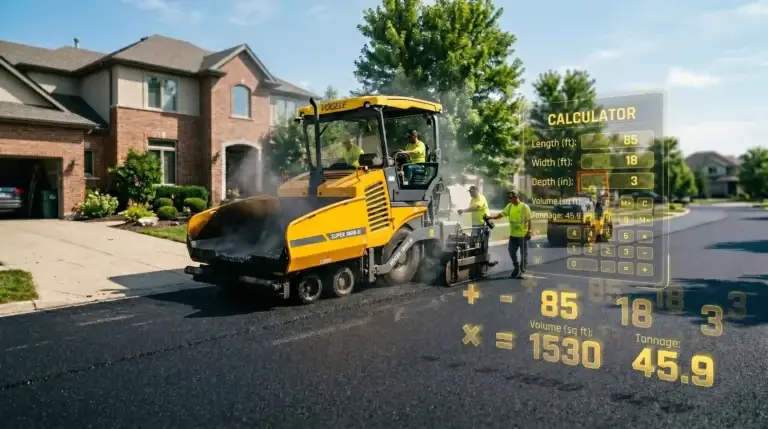
Use this free asphalt calculator to estimate how much asphalt you need for a driveway, parking lot, road, walkway, or repair project. Enter the length, width, depth, asphalt density, waste percentage, and price per ton to calculate estimated asphalt tons, cubic yards, total weight, and material cost.
This calculator is useful for homeowners, paving contractors, builders, property owners, and anyone planning an asphalt paving project in the USA. Whether you are estimating material for a small driveway or a larger parking area, this tool helps you understand how much asphalt may be required before ordering material.
For the most accurate result, confirm the final asphalt mix, density, compaction, and delivery quantity with your local asphalt supplier or paving contractor.
Asphalt Calculator Tool
Recommended calculator fields:
- Length
- Width
- Depth or thickness
- Measurement unit
- Asphalt density
- Waste percentage
- Price per ton
- Calculate button
Recommended result fields:
- Total area
- Volume in cubic feet
- Volume in cubic yards
- Estimated asphalt tons
- Estimated asphalt weight
- Estimated material cost
- Total asphalt with waste included
How to Use the Asphalt Calculator
Using the asphalt calculator is simple. First, enter the length and width of the area you want to pave. This gives the total surface area of your project.
Next, enter the asphalt depth or thickness. Asphalt depth is usually measured in inches for driveways, parking lots, and repair projects. A thicker asphalt layer will require more material.
Then, enter the asphalt density. If you are not sure about the exact density, you can use a common hot mix asphalt density estimate such as 145 lb/ft³. Actual density can vary depending on the asphalt mix, aggregate size, binder content, and compaction level.
Finally, enter the asphalt price per ton if you want to calculate the estimated material cost. The calculator will show the estimated asphalt quantity in tons, cubic yards, and total cost.
Asphalt Calculation Formula
The basic asphalt calculation formula is:
Volume = Length × Width × Depth
After calculating volume, multiply it by asphalt density:
Asphalt Weight = Volume × Asphalt Density
Then convert pounds into tons:
Tons of Asphalt = Total Pounds ÷ 2,000
So the full formula is:
Tons = Length × Width × Depth × Density ÷ 2,000
If your asphalt depth is entered in inches, convert it into feet first:
Depth in Feet = Depth in Inches ÷ 12
Example: If your area is 50 feet long, 20 feet wide, and 3 inches deep:
- Area = 50 × 20 = 1,000 sq ft
- Depth = 3 ÷ 12 = 0.25 ft
- Volume = 1,000 × 0.25 = 250 cubic ft
- Weight = 250 × 145 = 36,250 lb
- Tons = 36,250 ÷ 2,000 = 18.13 tons
- So, a 1,000 sq ft area at 3 inches thick may need about 18.13 tons of asphalt before adding waste.
Asphalt Tonnage Calculator
An asphalt tonnage calculator helps you estimate how many tons of asphalt are needed for your paving project. Asphalt is usually ordered by weight, so calculating tons is one of the most important steps before buying material.
The asphalt tonnage depends on:
- Length of the area
- Width of the area
- Asphalt thickness
- Asphalt density
- Compaction
- Waste allowance
- Type of asphalt mix
A thicker asphalt layer requires more tons. For example, a 4-inch asphalt surface will need more material than a 2-inch surface for the same area.
This asphalt calculator converts your measurements into estimated tons, so you can plan your material order more accurately.
Asphalt Cost Calculator
This page also works as an asphalt cost calculator. After calculating asphalt tons, enter your local asphalt price per ton to estimate the material cost.
The cost formula is:
Estimated Asphalt Cost = Tons of Asphalt × Price Per Ton
Example: If your project needs 18 tons of asphalt and your local asphalt price is $120 per ton, the estimated material cost is $2,160.
This estimate is for asphalt material only. It may not include labor, delivery, grading, base preparation, old pavement removal, compaction, taxes, or contractor charges.
Asphalt cost can change depending on your location, asphalt mix, supplier, oil prices, project size, delivery distance, and season.
How Much Asphalt Do I Need?
The amount of asphalt you need depends on the size of your project and the required asphalt thickness.
To estimate how much asphalt you need:
- Measure the length of the area
- Measure the width of the area
- Choose the asphalt depth
- Calculate the volume
- Multiply by asphalt density
- Convert the final weight into tons
For small projects, you can use the calculator to estimate asphalt for driveways, walkways, patch repairs, and private roads. For larger projects such as parking lots or commercial surfaces, the calculator can provide an early estimate, but a professional contractor should confirm the final material quantity.
If the area has an irregular shape, divide it into smaller rectangular sections. Calculate each section separately, then add the results together.
Asphalt Driveway Calculator
An asphalt driveway calculator helps homeowners estimate the amount of asphalt needed for a driveway project.
Driveway asphalt quantity depends on:
- Driveway length
- Driveway width
- Asphalt depth
- Vehicle weight
- Base condition
- Drainage
- Soil condition
- Climate
- Compaction
A light residential driveway may need less asphalt than a driveway used by heavy vehicles. If your driveway has weak soil, poor drainage, or an uneven base, you may need additional base preparation before installing asphalt.
For most driveway estimates, enter the driveway length, width, and planned asphalt thickness into the calculator. Then add a small waste percentage to avoid ordering too little material.
Asphalt Calculator for Parking Lots
You can also use this asphalt calculator for parking lot estimates. Parking lots usually require more planning than basic residential driveways because they handle more traffic and larger vehicles.
Parking lot asphalt quantity depends on:
- Total parking area
- Traffic load
- Asphalt thickness
- Base layer condition
- Drainage design
- Compaction requirements
- Asphalt mix type
A small private parking lot may need a moderate asphalt thickness, while a commercial lot with heavy traffic may require a thicker pavement structure.
Use this calculator for an initial estimate, then confirm the final quantity with a paving contractor before ordering asphalt.
Asphalt Thickness Guide
Asphalt thickness is one of the biggest factors in your material estimate. A small change in depth can significantly increase or decrease the number of tons required.
Use this general asphalt thickness guide for planning:
| Project Type | Common Asphalt Thickness |
| Light residential driveway | 2-3 inches |
| Strong residential driveway | 3-4 inches |
| Driveway with heavier vehicles | 4-6 inches |
| Small parking lot | 4-6 inches |
| Commercial parking lot | 6-8 inches |
| Road or heavy traffic area | Engineer-designed |
These numbers are general estimates. Final asphalt thickness should depend on soil condition, base preparation, drainage, vehicle load, climate, and local paving standards.
Asphalt Density Guide
Asphalt density affects the final tonnage calculation. If the density is higher, the same volume of asphalt will weigh more. If the density is lower, the same volume will weigh less.
Many asphalt calculators use a common hot mix asphalt density estimate of 145 lb/ft³. However, actual asphalt density can vary based on:
- Asphalt mix type
- Aggregate size
- Binder content
- Air voids
- Compaction level
- Supplier specifications
For the most accurate estimate, ask your asphalt supplier for the exact density of the mix you plan to use.
Types of Asphalt
There are different types of asphalt used for different paving needs. Choosing the right asphalt mix is important because each mix performs differently based on traffic, temperature, drainage, and project type.
Hot Mix Asphalt
Hot mix asphalt is one of the most common asphalt types used for roads, driveways, parking lots, and heavy-use surfaces. It is produced at high temperatures and is designed for strength, durability, and long-term performance. This is the type most people think of when estimating asphalt for paving projects.
Warm Mix Asphalt
Warm mix asphalt is produced at lower temperatures than hot mix asphalt. It can reduce energy use during production and may be useful in certain weather or project conditions.
Driveway Mix Asphalt
Driveway mix asphalt is commonly used for residential driveways and smaller paving projects. It is designed for lighter traffic compared with highways or commercial roads.
Porous Asphalt
Porous asphalt allows water to pass through the pavement surface into a prepared stone base below. It can help with drainage and reduce surface water buildup, but it usually requires proper base design.
Recycled Asphalt
Recycled asphalt uses reclaimed asphalt pavement from old roads, driveways, or parking lots. It can be used in some paving projects and may reduce material waste.
Waste and Compaction
You should usually add extra asphalt to your estimate because real projects are not always perfectly measured.
Extra asphalt helps cover:
- Uneven ground
- Compaction
- Material stuck in trucks or tools
- Edge loss
- Small measuring errors
- Irregular shapes
- Last-minute adjustments
For most small projects, a 5% to 10% waste allowance is a practical estimate. Large commercial projects should be checked by a paving contractor or engineer.
Asphalt Calculator Example
Let us estimate asphalt for a driveway.
Project details:
- Length: 60 feet
- Width: 18 feet
- Depth: 3 inches
- Density: 145 lb/ft³
- Price: $120 per ton
- Waste: 5%
Step 1: Calculate area
60 × 18 = 1,080 sq ft
Step 2: Convert depth into feet
3 ÷ 12 = 0.25 ft
Step 3: Calculate volume
1,080 × 0.25 = 270 cubic ft
Step 4: Convert volume into weight
270 × 145 = 39,150 lb
Step 5: Convert pounds into tons
39,150 ÷ 2,000 = 19.58 tons
Step 6: Add 5% waste
19.58 × 1.05 = 20.56 tons
Step 7: Estimate material cost
20.56 × 120 = $2,467.20
Estimated result: This driveway may need about 20.56 tons of asphalt, with an estimated material cost of $2,467.20.
Asphalt Calculator: Tons vs Tonnes
When calculating asphalt weight, it is important to understand the difference between tons and tonnes.
In the United States, asphalt is commonly measured using the short ton: 1 US ton = 2,000 pounds.
A metric tonne is different: 1 tonne = 1,000 kilograms.
If you are estimating asphalt in the USA, use tons. If you are using metric units, check whether your supplier uses tonnes.
Asphalt vs Blacktop
Asphalt and blacktop are often used as similar terms, but there can be small differences in mix design and use.
Asphalt is commonly used for roads, highways, parking lots, and large paving projects. Blacktop is often used for driveways, paths, and smaller residential surfaces.
For calculator purposes, both asphalt and blacktop can usually be estimated using the same method: length × width × depth × density. However, the exact mix, density, and installation method may vary.
FAQs
Multiply length × width × thickness (in feet), apply density, and divide by 2000.
Convert square yards into square feet, then apply thickness and density using the tonnage formula.
Use the standard formula or an asphalt calculator for instant results.
Measure area, choose thickness (usually 2–3 inches), and calculate tonnage using a calculator.
Break the project into sections, calculate each area, and sum total tonnage using an asphalt tonnage calculator.