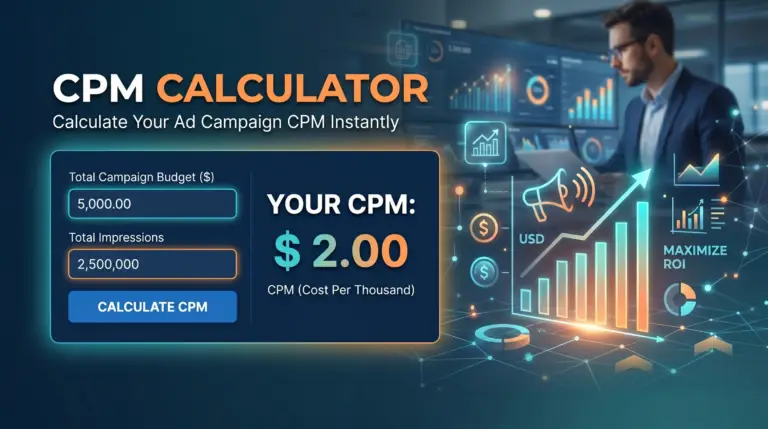
CPM Calculator
What is CPM? Understanding Cost Per Mille
CPM stands for Cost Per Mille, which is Latin for ‘cost per thousand.’ In digital advertising, CPM represents the cost an advertiser pays for 1,000 ad impressions on a webpage, app, or other digital platform.
CPM is one of the most fundamental metrics in digital marketing and online advertising. It helps advertisers and publishers:
- Budget effectively – Plan advertising campaigns with predictable costs
- Compare platforms – Evaluate different advertising channels
- Measure reach – Understand how many people see your ads
- Calculate ROI – Determine if your advertising investment is worthwhile
- Negotiate rates – Have data-driven conversations with publishers
Why is CPM Important for Digital Marketers?
CPM pricing is crucial because it provides a standardized way to compare advertising costs across different platforms, campaigns, and publishers. Whether you’re running ads on Facebook, Google Display Network, YouTube, or programmatic platforms, CPM gives you a common metric to evaluate efficiency.
How to Calculate CPM: The Complete Formula Guide
CPM Formula
The CPM calculation formula is straightforward and consists of three variables: total cost, total impressions, and the CPM value itself.
CPM = (Total Campaign Cost ÷ Total Impressions) × 1000
Alternative Formulas
Calculate Total Cost from CPM
Total Cost = (CPM × Total Impressions) ÷ 1000
Calculate Total Impressions from CPM
Total Impressions = (Total Cost ÷ CPM) × 1000
Step-by-Step CPM Calculation Examples
Example 1: Calculate CPM
Scenario: You spent $500 on an ad campaign that received 200,000 impressions.
- Total Cost = $500
- Total Impressions = 200,000
- CPM = ($500 ÷ 200,000) × 1000
- CPM = 0.0025 × 1000
- Result: CPM = $2.50 (you paid $2.50 for every 1,000 impressions)
Example 2: Calculate Campaign Cost
Scenario: A publisher offers a CPM of $8, and you want 500,000 impressions.
- CPM = $8
- Total Impressions = 500,000
- Total Cost = ($8 × 500,000) ÷ 1000
- Result: Total Cost = $4,000
CPM Rates by Platform: 2026 Industry Benchmarks
Understanding average CPM rates helps you evaluate if you’re overpaying or getting a good deal. Here are current benchmarks across major advertising platforms:
| Platform | Average CPM Range | Best For |
|---|---|---|
| Facebook / Instagram | $5 – $15 | Social brand awareness, retargeting |
| Google Display Network | $0.50 – $4 | Wide reach, remarketing |
| YouTube | $6 – $20 | Video awareness, product demos |
| $25 – $50 | B2B targeting, professional audiences | |
| Twitter / X | $4 – $10 | Real-time engagement, news topics |
| TikTok | $8 – $20 | Gen Z reach, viral campaigns |
| Programmatic Display | $0.50 – $3 | Scale and retargeting |
| Podcast Advertising | $15 – $30 | Niche, high-engagement audiences |
CPM Benchmarks by Industry
| | ||
|---|---|---|
| Industry | Average CPM | Competition Level |
| Finance & Insurance | $15 – $40 | Very High |
| Healthcare | $10 – $30 | High |
| Technology (B2B) | $12 – $35 | High |
| E-commerce / Retail | $5 – $15 | Medium-High |
| Education | $4 – $12 | Medium |
| Entertainment | $3 – $10 | Medium |
| Travel & Hospitality | $5 – $15 | Medium |
| Gaming | $2 – $8 | Low-Medium |
Difference between CPM vs CPC vs CPA: Which Pricing Model is Right for You?
CPM (Cost Per Mille)
Pay for every 1,000 impressions, regardless of clicks or conversions.
- Best for: Brand awareness, reach campaigns, video views
- Risk: You pay even if no one clicks
- Benefit: Predictable costs, maximum reach
CPC (Cost Per Click)
Pay only when someone clicks on your ad.
- Best for: Traffic generation, lead generation
- Risk: Can be expensive in competitive niches
- Benefit: Only pay for engaged users
CPA (Cost Per Acquisition)
Pay only when a specific action is completed (purchase, signup, etc.).
- Best for: Direct response, e-commerce conversions
- Risk: Publisher takes on more risk, may charge premium
- Benefit: Most ROI-focused pricing model
How to Optimize and Lower Your CPM: 12 Proven Strategies
Refine Your Target Audience
Paradoxically, narrower targeting can lower CPM by reducing wasted impressions. Focus on audiences most likely to engage with your content.
Improve Ad Creative Quality
High-quality, engaging ads get better placements and lower costs on platforms like Facebook and Google. Invest in professional design and compelling copy..
Test Multiple Ad Formats
Video, carousel, static images, and stories all have different CPMs. Test to find the most cost-effective format for your goals.
Optimize Ad Relevance Score
Platforms reward relevant ads with lower costs. Ensure your ad copy, creative, and landing page are aligned with user intent.
Avoid Peak Competition Times
If possible, run campaigns during off-peak seasons or hours when competition (and CPMs) are lower.
Use Frequency Capping
Prevent ad fatigue by limiting how often the same user sees your ad. This maintains engagement and prevents CPM inflation.
Exclude Irrelevant Placements
Review placement reports and exclude underperforming sites, apps, or locations that drive up costs without delivering results.
Leverage Retargeting Wisely
Retargeting campaigns often have higher CPMs but better conversion rates. Balance reach campaigns with targeted retargeting.
A/B Test Everything
Continuously test headlines, images, CTAs, and targeting to find combinations that deliver lower CPMs and better performance.
Choose the Right Bidding Strategy
Manual bidding can give you more control, while automated bidding can find efficiencies at scale. Test both approaches.
Improve Landing Page Experience
Better post-click experiences improve Quality Score on platforms like Google, which can lower your effective CPM.
Monitor and Adjust Regularly
CPM rates fluctuate. Regular monitoring allows you to pause underperforming campaigns and scale winners quickly.
7 Common CPM Mistakes to Avoid
Mistake #1: Only Focusing on Low CPM
A $2 CPM with 0.1% conversion rate is worse than a $10 CPM with 2% conversion rate. Always consider the full funnel, not just top-of-funnel metrics.
Mistake #2: Ignoring Ad Frequency
High frequency (showing the same ad too many times) increases CPM and decreases effectiveness. Monitor frequency caps carefully.
Mistake #3: Not Tracking View-Through Conversions
CPM campaigns build awareness that may convert later. Use view-through attribution to measure true impact.
Mistake #4: Comparing CPMs Across Different Platforms
Facebook CPM of $8 isn’t directly comparable to Google Display CPM of $3 because audience quality, intent, and engagement differ drastically.
Mistake #5: Setting and Forgetting Campaigns
CPM rates change based on competition, seasonality, and platform updates. Regular optimization is essential.
Mistake #6: Not Considering Viewability
An impression only counts if it’s viewable. Ensure ads appear in visible locations to get value from your CPM spend.
Mistake #7: Overlooking Brand Safety
Low CPM placements on questionable sites can damage your brand. Invest in brand-safe, quality inventory even at higher CPMs.
Conclusion: Master CPM for Better Advertising Results
Understanding and optimizing CPM is essential for any digital marketer or advertiser. While it’s just one metric in your marketing toolkit, mastering CPM calculations helps you:
- Budget accurately for advertising campaigns
- Compare different advertising platforms objectively
- Negotiate better rates with publishers
- Identify optimization opportunities
- Calculate true marketing ROI
Remember that the lowest CPM isn’t always the best. Focus on reaching the right audience with engaging content, and measure success based on your ultimate business goals — whether that’s brand awareness, traffic, leads, or sales.